

The Night the Money Ran Out
It was the twenty-seventh of the month. The salary was due on the first.
Four days. That is all that stood between my family and the next paycheck. Four days, and the small envelope in the kitchen drawer was empty.
I was twelve years old. I did not understand interest rates. I had never heard the phrase “paycheck to paycheck.” I did not need to. I could feel it. I could feel it in the way my mother stopped adding sugar to her tea. I could feel it in the way my father came home a little quieter each evening. I could feel it in the way the small light above the stove stayed on later than usual, because the kitchen was where the math was being done.
That phrase, paycheck to paycheck, would arrive in my vocabulary years later. The feeling arrived first. The feeling was this. That the money ran out before the month did. That the next paycheck was not a hope. It was a lifeline. And until it landed, the family held its breath.
I want to tell you something I have learned since then, in fourteen years of running a marketplace with one hundred and fifty shops, in years of watching thousands of families pay rent, pay bills, and try to make it to the first of the next month.
Living paycheck to paycheck is not a personal failure. It is a condition. And like any condition, it has a cause, and it has a way out.
If you are reading this article, you probably searched for the words “how to stop living paycheck to paycheck.” I am glad you did. You are in the right place. This is the article I wish someone had handed my parents when I was twelve. It is also the article I wish someone had handed me, on the day I got my first real paycheck and felt, for the first time, the quiet fear of watching it disappear by the third week of the month.
Let us walk through this together. Slowly. Honestly. With real numbers, real research, and a real way out.
What Does It Mean to Live Paycheck to Paycheck?

Let us begin with the words themselves, because the words matter.
Living paycheck to paycheck means that your income barely covers your expenses. By the time the next payday arrives, there is little or nothing left from the last one. One missed paycheck, one surprise bill, one car repair, one medical charge, and the whole month falls apart.
Bankrate, in a July 2024 survey, defined it precisely. Living paycheck to paycheck means having little to no money left for savings after paying monthly bills 1.They found that thirty-four percent of U.S. workers, more than one in three, fit that description. The number rose to forty-three percent in rural areas, fell to thirty-five percent in the suburbs, and sat at thirty-one percent in cities 1.
Other surveys, using a broader definition, find higher numbers. LendingClub, in its Paycheck-to-Paycheck Report, has consistently found that around sixty percent of U.S. consumers live this way 2. PYMNTS, which co-publishes the report, found that sixty-one percent of U.S. consumers were living paycheck to paycheck as of late 2022, up seven percentage points since May 2021 3.
Why the gap between thirty-four percent and sixty percent? It depends on the question asked. Bankrate asks whether people have money left for savings. LendingClub asks whether people live paycheck to paycheck without regard to income. The truth, depending on how you measure it, is somewhere in between. But the shape of the truth is the same. A very large share of ordinary people, in one of the wealthiest countries in the world, are running on empty before the month is over.
Why So Many People Live This Way
It is tempting to blame the person. To think that people who live paycheck to paycheck must be careless. Must be bad with money. Must have brought it on themselves.
The numbers do not support that story.
The U.S. Bureau of Economic Analysis reported that the personal saving rate — the percentage of disposable income that Americans actually save — was 4.1 percent in August 2026 4. The historical average going back to 1959 is approximately 8.4 percent. We are, as a country, still saving significantly less than the long-term norm.
Baird Wealth confirms the trend. The U.S. personal saving rate stood at 3.6 percent at the end of 2025, down from 4.3 percent at the end of 2024 5. This is not a one-year blip. This is a slow, decade-long decline.
Some of this is structural. Wages have not kept pace with the cost of housing, healthcare, and education. A single surprise expense can wipe out months of careful saving. A 2023 Federal Reserve survey, the Survey of Household Economics and Decisionmaking, found that many adults would struggle to cover even a $400 emergency with cash 6. I cited that number in the first article on this site, and it is worth repeating here. It is the clearest single statistic I know for explaining why so many people live on the edge.
But some of this is also behavioral. And behavior is the part you can change. That is what the rest of this article is about.
Step One: Find Out Where Your Money Actually Goes
I wrote about this in the first article on Savvy Broke. I am going to write about it again, because it is the foundation of every other step.
You cannot fix what you cannot see.
If you ask most people how much they spend in a month, they will give you a number. If you ask them how much they spend on coffee, on snacks, on subscriptions they forgot they had, on small fees they did not notice, they will give you a much smaller number, or no number at all. The gap between those two answers is where the leak is.
For thirty days, write down every single thing you spend money on. Use a notebook. Use a free app. Use the back of a receipt. The tool does not matter. The discipline does. Bank of America’s Better Money Habits program calls this the first step of saving 7. The Consumer Financial Protection Bureau says the same 8. I say the same. There is no way around it.
A Simple Tracking System
Take a piece of paper. Make three columns. Label them. What I spent on. How much. Need or want.
Need means food, rent, medicine, basic transport, school fees, the minimum utility bills. Want means everything else. The line between them is not always clean. That is fine. The point is not perfection. The point is to start seeing.
At the end of thirty days, do not judge. Just look. The numbers will tell you a story. The story is almost always the same. A lot of small leaks. A few large ones. A handful of subscriptions you forgot you were paying for. A pattern of spending that you did not see, because you were not looking.
For more on why those small spends happen, read why we buy things we don’t need. Understanding the want is half the work of stopping it.
Step Two: Protect Your Four Walls First
When you are broke, the world feels like it is asking for money from every direction at once. The rent. The electricity. The phone. The school. The credit card. The neighbor you borrowed from. The list does not end.
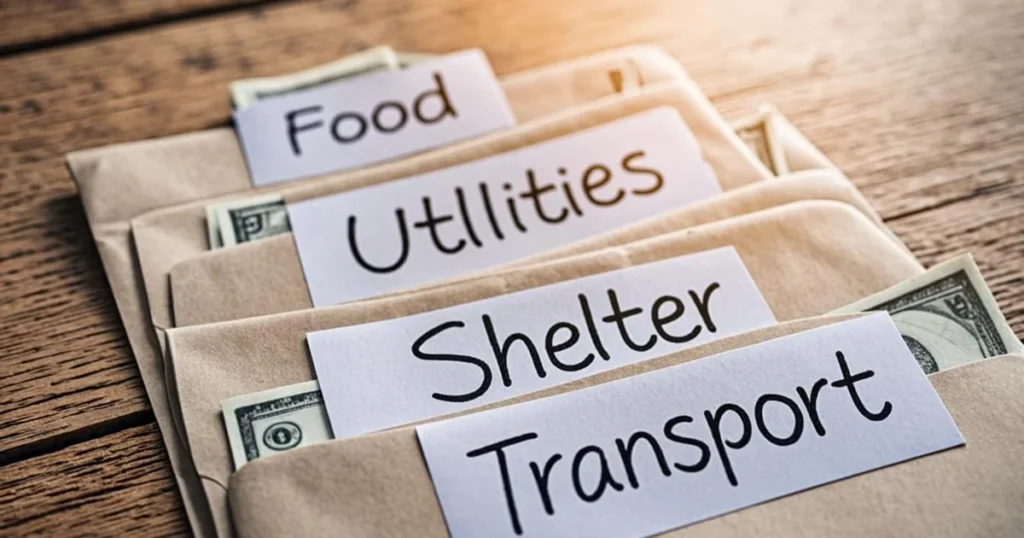
Here is a frame that has helped thousands of families, including some I have watched in our own marketplace. It is called the Four Walls. It comes from Dave Ramsey, the personal finance author, and it is widely taught by credit counselors, banks, and credit unions 9. The idea is simple. When money is short, you do not divide it equally. You protect four things first, in this order. Food. Utilities. Shelter. Transportation.
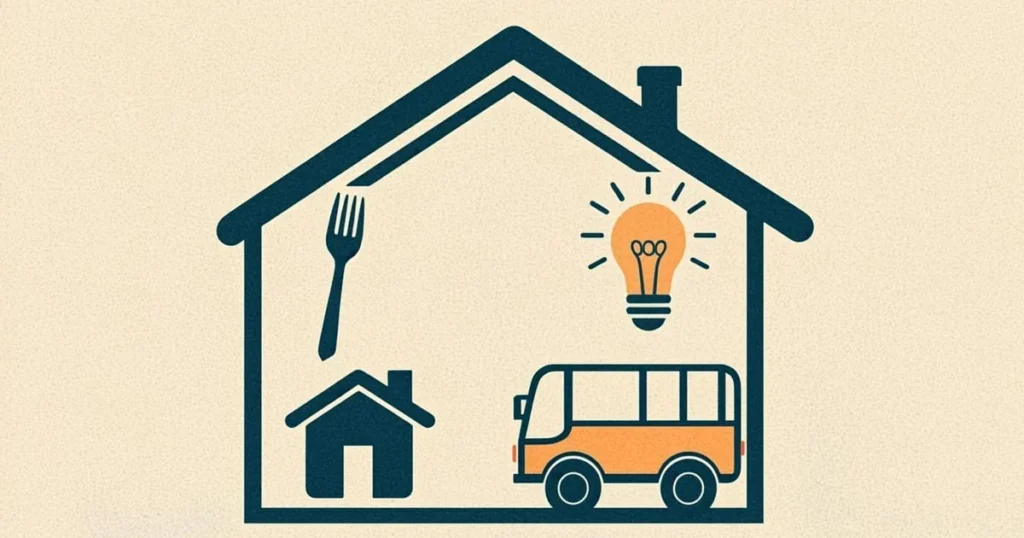
When money is short, you do not divide it equally. You protect four things first. Food. Utilities. Shelter. Transportation.
Wall One: Food
Food comes first because a hungry family cannot solve any other problem. Plan meals in advance. Cook at home more. Buy in bulk where it makes sense. The goal is not to eat less. The goal is to eat deliberately. I have watched families in our marketplace cut their food bills by a third just by planning the week instead of buying day by day.
Wall Two: Utilities
Electricity. Water. Gas. Phone. These keep the household running. They are not optional. But they can almost always be trimmed. A few degrees on the thermostat. A shorter shower. A phone plan you have not revisited in three years. The savings are small per item. Together, they add up.
Wall Three: Shelter
Rent or mortgage. This is the payment that, if missed, costs you the roof over your head. It comes before the credit card. It comes before the personal loan. It comes before the family you borrowed from. If you can only pay one thing this month, pay this. Everything else can be negotiated. The roof cannot.
Wall Four: Transportation
Bus fare. Gas. Car payment. Insurance. The thing that gets you to work. If you cannot get to work, you cannot earn. If you cannot earn, every other problem gets worse. So protect the means of earning, even if it means letting other bills wait.
Notice what is not on the list. The credit card minimum. The streaming subscription. The new shoes. The gift for the wedding next month. These things are not bad. They are simply not walls. When the building is shaking, you do not water the plants. You brace the walls.
Step Three: Build a Starter Emergency Fund of $1,000

This is the step that turns the corner. And it is the step most people skip, because it feels impossible when you are broke.
Here is the goal. Save your first one thousand dollars. Not a year of expenses. Not three months of salary. One thousand dollars. That is the starter. That is the first wall against the next surprise.
Why one thousand? Because research backs it up. Vanguard, in a study of financial well-being, found that having at least $2,000 in emergency savings was associated with a twenty-one percent higher level of financial well-being than having none 10. A separate peer-reviewed study by Zhang, published in 2026, found that an emergency fund significantly reduces the likelihood of accumulating debt and preserves resilience during crises 11. CNBC, reporting on Vanguard’s research in May 2025, summarized it this way. Having even a small emergency fund can make you measurably happier and less stressed 12.
So we start small. One thousand dollars. Two thousand if you can reach it. Not as a final goal. As a beachhead.
How to Find the First $1,000
I am going to give you four ways. Pick one. Try it. If it does not work, try another. None of these are magic. All of them are real.
Way One: Sell What You No Longer Use
This is the fastest. Almost every home has a few hundred dollars of unused things. Old phones. Clothes that have not been worn in a year. Books you will not read again. The appliance you replaced. I wrote about this in the third article on Savvy Broke. The shopkeepers in our marketplace who survived the hardest months were the ones who knew how to clear inventory. Households work the same way.
Way Two: Pause Every Subscription for One Month
Cancel them all. Not forever. For one month. Streaming. Apps. Gym. Boxes that arrive monthly. The things that quietly charge your card. At the end of the month, look at what you actually missed. Add back only those. The rest stay gone. Most people are surprised how much they were paying for things they did not use.
Way Three: Pick Up One Small Side Income
I started earning at fourteen by giving tuitions. You do not have to start that young. SurveyMonkey, in a 2025 study, found that seventy-two percent of U.S. workers either have a side hustle or are considering one 13. CNBC reported in 2024 that the average side hustler brings in $891 per month 14. That is almost your starter emergency fund in a single month. Pick something small. Tutoring. Freelance writing. Driving for a rideshare. Selling baked goods. The specifics matter less than the start.
Way Four: Negotiate One Bill
Call your phone company. Call your internet provider. Call your car insurance. Tell them you are thinking of switching. Ask what they can do. You will be surprised how often they lower the rate. I have watched shopkeepers do this with their own suppliers for years. The same skill works at home. Most people never call, because they assume the answer is no. The answer is often not no. The answer is often “let me see what I can do.”
Step Four: Pick a Budget That Actually Fits Your Life
A budget is not a punishment. A budget is a plan for telling your money where to go, instead of wondering where it went. I wrote about the 50/30/20 rule in the first article on Savvy Broke. I want to introduce you to two more methods here, because different lives need different budgets.
Method One: The 50/30/20 Rule (For People Who Want Simple)
Elizabeth Warren and Amelia Warren Tyagi introduced this in their 2005 book All Your Worth. Fifty percent of your income goes to needs. Thirty percent to wants. Twenty percent to savings and debt. It is clean. It is easy to remember. It works well when your income is steady and your needs are not eating up more than half of it. If your needs are already at 80 percent, this rule will frustrate you. Adjust the percentages. The rule is a guide, not a law.
Method Two: Zero-Based Budgeting (For People Who Want Control)
Zero-based budgeting is the method I would use if I were starting today. Investopedia, NerdWallet, Fidelity, and Citizens Bank all describe it the same way 15. The idea is this. Every single dollar of income gets a job, before the month begins. If you bring in three thousand dollars, you assign all three thousand dollars. Rent gets some. Food gets some. Gas gets some. Savings gets some. Debt gets some. The number at the bottom of the plan is zero. Not because you spent it all. Because every dollar has been given a purpose.
This sounds rigid. It is not. It is the opposite. It gives you control. You stop wondering where the money went, because you decided where it was going to go, before it had a chance to wander off.
I have run the books of a marketplace for years. The shopkeepers who survive the hardest months are not the ones with the most sales. They are the ones who know, in advance, where every rupee is going. The same is true for households.
Method Three: Pay Yourself First (For People Who Have Tried and Failed at Budgets)
If you have tried to budget and failed, try this instead. The day money comes in, move a small piece of it to savings, before you pay anything else. Even one percent. Even five dollars. Then live on the rest. I wrote about this in the first article on Savvy Broke. The method is old. It is mentioned in The Richest Man in Babylon, a book from 1926 16. It works because it removes the choice. Saving becomes a fact, not a fight.
Step Five: Automate the Cycle Break

Here is where the research gets interesting.
In 2003, two researchers, Richard Thaler and Shlomo Benartzi, published a study on a program they called Save More Tomorrow. The idea was simple. Instead of asking people to choose to save, they enrolled them in saving automatically. People could still opt out. But they did not have to opt in.
The results were striking. Enrollment in saving went up dramatically. The study has been cited over forty-five hundred times by other researchers 17. It changed how the entire field thinks about saving.
Here is the lesson for you. Do not rely on willpower. Willpower fails at nine at night, after a long day, when the bill is staring at you. Rely on automation instead.
Set up an automatic transfer from your checking account to your savings account. Same day every week. Same amount. Small, if it has to be. Ten dollars. Twenty. Whatever you can sustain. The money moves before you see it. You do not spend it because it is not there to spend.
If your bank does not offer automatic transfers, set a phone alarm. Same day. Same time. When it rings, you move the money. Treat it like brushing your teeth. Not a decision. A thing you do.

I have watched this work in our marketplace for years. The shopkeepers who separate the money at the start of the day survive the hard months. The ones who leave it all in one pile and decide later sit with a calculator at the end of the month, wondering where it went.
Step Six: Attack the Debt That Is Eating the Paycheck
I wrote an entire article about this, the fourth on Savvy Broke, called The Quiet Emergency. I am not going to repeat all of it here. But I have to mention it, because for many people living paycheck to paycheck, debt is the reason.
Credit card debt in the United States crossed $1.26 trillion in 2026, according to the Federal Reserve Bank of New York 18. The average interest rate on a new credit card offer climbed above 23 percent, according to LendingTree 19. If you are carrying credit card debt at that interest rate, every dollar of that debt is eating your future paychecks before they even arrive.
Here is the short version of what to do. Stop adding to the debt. The card comes out of the wallet. Pick a method. The snowball, paying off the smallest debt first, has been shown by researchers at Northwestern University’s Kellogg School to be more effective for most people, because the small wins keep them going 20. The avalanche, paying off the highest-interest debt first, is mathematically cheaper. Pick the one you will actually walk. Call your bank and ask about hardship programs. Pay a little more than the minimum, every month, no matter how small the extra. And if the math does not work, talk to a nonprofit credit counselor. The Consumer Financial Protection Bureau can point you to one 21.
If this is you, please read the full article on debt. The short version here is not enough. The long version is the one that might actually get you out.
Step Seven: Increase the Income Side of the Equation

I have saved this one for near the end, because it is the one most people want to start with, and the one that takes the longest.
Cutting spending works up to a point. Then there is nothing left to cut. At that point, the only path forward is to earn more. I wrote about this in the third article on Savvy Broke, called The Other Side of Broke. The average side hustler in the United States earns around $891 per month, according to 2024 data from CNBC 14. For a family that is short at the end of the month, even two hundred extra dollars can be the difference between a crisis and an inconvenience.
I am not going to repeat the whole article here. But I will say this. The path to earning more begins with what you already have. A skill. A few spare hours. A thing you can sell. A neighbor who would hire you, if you only asked. Start there. The first dollar is the hardest. Everything after that is repetition.
Step Eight: Have the Money Conversation

This is the step almost no personal finance article mentions. I want to mention it, because it is the one that, in my experience, changes everything.
Sonya Britt, a researcher at Kansas State University, published a study in 2013 in the journal Family Relations. She analyzed over forty-five hundred couples. She found that arguments about money were the top predictor of divorce, more than children, sex, in-laws, or religion. Controlling for income, debt, and net worth 22.
If you are living paycheck to paycheck and you have not told your partner, your parents, or the people who depend on you, the silence is part of what is keeping you stuck. The money conversation is the one that releases the pressure. I wrote an entire article about how to have it, the fifth on Savvy Broke. If you have not read it yet, please read it after this one. It may be the most important of all six.
The short version. Pick a quiet evening. Begin not with the numbers. Begin with the question. Tell the truth, the way you would want it told to you. Listen more than you speak. Do not try to solve everything that night. Just start. Starting is more than half the work.
The Behavioral Insight That Ties It All Together
I want to leave you with one piece of research that changed the way I think about all of this.
The economist Richard Thaler, who would go on to win the Nobel Prize in Economics in 2017, developed a concept called mental accounting. The idea is simple. People put different mental labels on different money. Salary money feels heavy. Bonus money feels lighter. Tax refund money feels almost like a gift. Found money feels lighter still.
The bills are the same. The numbers are the same. But the mental label changes how easily we let them go.
Here is why this matters for breaking the paycheck-to-paycheck cycle. The cycle is not just a math problem. It is a mental accounting problem. The money you earn feels different from the money you save, even when it is the same money. The money you receive as a bonus feels lighter than the money you earn in salary, even when the amount is identical.
The fix is not to fight the labeling. The fix is to use it. Label your savings deliberately. Call it the emergency fund. Call it the rent for next month. Call it the car repair fund. Give it a name and a purpose. The moment money has a name, it becomes harder to spend it on something else.
I have watched shopkeepers in our marketplace do this for years. They label the envelopes. Rent. Supplier. Salary. Repair. The moment the envelope has a name, the money inside it stops being available for impulse. The label does the work that willpower cannot.
When Breaking the Cycle Is Not About Personal Behavior
I want to be honest with you, the way I have tried to be honest everywhere on this site.
Not every case of living paycheck to paycheck can be solved by tracking, budgeting, and side hustles. Sometimes the math simply does not work. Sometimes the income is too low. Sometimes the cost of living in a particular city is too high. Sometimes there is a medical crisis, a job loss, a family emergency, a divorce, a death, and no amount of personal behavior could have prevented the slide.
When Income Is the Problem, Not Behavior
If your income is below the cost of basic needs in your area, no budget will fix that. The budget will help you see the gap. It will not close it. Closing the gap requires either higher income, lower cost of living (which may mean moving), or outside help. None of these are failures. They are tools. There are government programs, nonprofit organizations, community resources, and faith-based assistance programs that exist for exactly this situation. Using them is not weakness. I have lived through that kind of help. I would not be writing this without it.
When You Are Already Doing Everything Right
If you are already tracking, already cutting, already side-hustling, already communicating, and you are still living paycheck to paycheck, please hear me. You are not failing. The system around you may be failing you. Wages that have not kept pace with housing. Healthcare costs that have outpaced inflation. Student debt that did not buy the income it promised. These are not personal failings. These are structural ones. And while we cannot fix them in a single article, we can name them honestly, so you do not carry the weight of a problem you did not create.
A Note on What I Cannot Tell You
I am not a certified financial planner, a credit counselor, a tax professional, or a bankruptcy attorney. I hold a degree in Commerce. I have spent years managing real businesses and a marketplace with one hundred and fifty shops. But I do not have a license to give you personal financial advice. Everything in this article is shared for general information and education. Your situation is yours. If you are about to make a major decision, please talk to a qualified professional who can look at your specific situation. The cost of that conversation is small. The cost of getting it wrong is large.
Frequently Asked Questions
These are the questions I am asked most often, by readers of the previous articles on Savvy Broke and by people I have met in the marketplace over the years. I will answer each as honestly as I can, with the same disclaimer I give everywhere on this site. I am sharing experience and research, not personal financial advice.
Q: What does it mean to live paycheck to paycheck?
It means your income barely covers your expenses, and by the time your next payday arrives, there is little or nothing left from the last one. Bankrate, in a 2024 survey, defined it as having little to no money left for savings after paying monthly bills. They found that thirty-four percent of U.S. workers fit this description [1]. Other surveys, using a broader definition, find the number closer to sixty percent [2]. Either way, it is a very large share of ordinary people.
Q: How much should I have in an emergency fund before I am no longer living paycheck to paycheck?
Start with a starter emergency fund of $1,000. That is the beachhead. Vanguard research found that having at least $2,000 in emergency savings was associated with a twenty-one percent higher level of financial well-being [10]. Once you reach $1,000, aim for one month of expenses, then three. But do not wait for three months before you feel like you have started. The first $1,000 is the one that changes the feeling. The larger funds come later.
Q: What is the best budget for someone living paycheck to paycheck?
The one you will actually keep. For most people starting out, I recommend zero-based budgeting, where every dollar gets a job before the month begins. Investopedia, NerdWallet, Fidelity, and Citizens Bank all describe this method [15]. If zero-based feels too rigid, try the 50/30/20 rule, or the pay-yourself-first method. The best budget is not the one that looks perfect on paper. It is the one you can stick to in the third month, when the newness has worn off and the work is still hard.
Q: Should I pay off debt or build savings first?
Build a small starter emergency fund first, even while you still have debt. Aim for $1,000. Then attack the debt. The reason is simple. If you put every dollar toward debt and an emergency hits, you have nothing to fall back on except more debt, which puts you back where you started. A small buffer breaks that loop. I wrote about this in detail in the fourth article on Savvy Broke, The Quiet Emergency. If debt is your main problem, please read that one next.
Q: How can I save money when I have nothing left at the end of the month?
Save before the end of the month, not after. The day money comes in, move a small piece of it to savings, before you pay anything else. Even one percent. Even five dollars. This is the pay-yourself-first method. It works because it removes the choice. If you wait until the end of the month, the money will already be gone. Money always finds somewhere to go. Decide where it goes before it lands.
Q: Is living paycheck to paycheck normal?
It is common. That is not the same as normal. Bankrate found that thirty-four percent of U.S. workers live this way 1. LendingClub’s broader measure puts it closer to sixty percent 2. So if this is you, you are in very large, very ordinary company. But common does not mean it has to be permanent. The fact that so many people live this way is a sign of how hard it is, not a sign that you should accept it forever.
Q: How long does it take to break the paycheck-to-paycheck cycle?
Longer than a month. Shorter than a lifetime. Research on habit formation, which I cited in the first article on this site, found that it takes an average of sixty-six days for a new behavior to feel automatic, with a wide range from eighteen days to over two hundred. Budgeting, saving, and tracking are habits. They take time to feel normal. Give yourself that time. The first month is the hardest. The third month is when it starts to feel like who you are.
Q: What if I have already cut everything and I am still broke?
Then the answer is no longer on the spending side. It is on the earning side. I wrote an entire article about this, the third on Savvy Broke, called The Other Side of Broke. The average side hustler in the United States earns around $891 per month [14]. For a family that is short at the end of the month, even a few hundred extra dollars can be the difference between surviving and breathing. If you have already cut, please read that article next. The path forward may be on the income side of the equation.
Q: Should I tell my partner I am living paycheck to paycheck?
Yes. Carefully. The money conversation is the one most couples never have, and the silence around money is one of the things that keeps people stuck. Sonya Britt’s research at Kansas State University found that arguments about money are the top predictor of divorce, more than children, sex, in-laws, or religion 22. The Gottman Institute found that in ninety-four percent of arguments, the way the discussion starts is how it ends. Begin softly. Begin not with the numbers. Begin with the question. I wrote a full article about how to have this conversation, the fifth on Savvy Broke. If this is you, please read it.
Q: Is it ever too late to stop living paycheck to paycheck?
No. I have watched shopkeepers in our marketplace turn things around in their fifties. I have watched people in their sixties build their first real emergency fund. The math is the same at every age. The habits are the same at every age. The only thing that age changes is how much runway you have. But runway is not the same as possibility. As long as you are breathing, the possibility is there. Start where you are. Use what you have. The first step is the smallest one. Take it today.
What I Would Tell My Father, If I Could Go Back to That Kitchen
I want to end where I began. In that kitchen. With the small light above the stove. With my father doing the math on the twenty-seventh of the month, four days before the salary landed.

If I could go back, I would not tell him the numbers. He already knew the numbers. I would not tell him the methods. He was already using the ones he knew.
I would tell him one thing. The thing this entire article has been trying to say.
You are not alone in this. The money runs out before the month does for one in three workers in this country, and for closer to six in ten by a broader measure. The fact that it is happening to you does not mean you failed. It means you are in a condition that has a cause, and that has a way out.
The way out begins with seeing where the money goes. Then protecting the four walls. Then building a starter emergency fund, even a small one, even one thousand dollars. Then picking a budget you can actually keep. Then automating the savings so you do not have to fight for it every month. Then attacking the debt that is eating the future. Then earning more, with what you already have. Then having the conversation, with the people who share the roof, that you have been postponing.
None of these steps are fast. All of them are real. Together, they break the cycle.
I have spent my life watching money, in my own family and in the families of hundreds of shopkeepers. I have seen the cycle. I have seen people break it. The difference between the ones who broke it and the ones who did not was never income, talent, or luck. The difference was the willingness to start, and the willingness to keep going past the third month, when the newness had worn off and the work was still hard.
If you have read this far, you have already started. The next step is smaller than you think. Pick one thing from this article. One step. Track your spending for thirty days. Cancel one subscription. Move five dollars to savings today. Have one money conversation this week.
Do one thing. Today.
* * *
The small light above the stove can go off now.
The math does not need to be done at midnight anymore.
The next paycheck will still come. But this time, when it lands, you will know where it is going. You will have decided before it arrived. You will have a plan, a buffer, a partner who knows the truth, and a path that, for the first time in a long time, leads somewhere other than back to the start.
That is what it means to stop living paycheck to paycheck. Not that the money is suddenly plenty. That the fear is suddenly smaller. That the month is suddenly survivable. That the next surprise, when it comes, becomes a problem instead of a crisis.
The cycle breaks one dollar at a time. One conversation at a time. One month at a time.
Start tonight.
A Quick Note From Tehseen
I am not a certified financial planner, chartered accountant, investment advisor, tax professional, credit counselor, or bankruptcy attorney. I hold a degree in Commerce and have spent years managing business accounts and a marketplace with one hundred and fifty shops. Everything on Savvy Broke is shared for general information and education, not as personal financial advice. If you are about to make a major financial decision, please speak with a qualified professional who understands your situation. If you are in genuine crisis, please reach out to a nonprofit credit counselor or a community assistance program. Asking for help is not weakness. I have lived through that kind of help. I would not be writing this without it.
References
Sources are listed below. Links were checked at the time of writing in October 2026.
- Bankrate. (2024, July 15). More Than A Third of Workers Say They’re Living Paycheck to Paycheck. Reports that 34% of U.S. workers live paycheck to paycheck, defined as having little to no money left for savings. Rural 43%, suburban 35%, urban 31%. Available at: https://www.bankrate.com/banking/savings/living-paycheck-to-paycheck/ ↩︎
- LendingClub. (2023). New Reality Check: The Paycheck-To-Paycheck Report. PYMNTS. Reports that approximately 60% of U.S. consumers were living paycheck to paycheck in 2023, with 19% struggling to pay monthly bills. Available at: https://www.pymnts.com/study/paycheck-to-paycheck/ ↩︎
- PYMNTS. (2023, January). The Paycheck-To-Paycheck Report: 61% of U.S. consumers were living paycheck to paycheck in December 2022, up 7 percentage points since May 2021. Available at: https://www.pymnts.com/paycheck-to-paycheck-report/ ↩︎
- U.S. Bureau of Economic Analysis. (2026, March 17). Personal Income and Outlays, July 2026. Reports the U.S. personal saving rate at 3.0 percent in July 2026. Available at: https://www.bea.gov/news/2026/personal-income-and-outlays-july-2026 ↩︎
- Baird Wealth Management. (2026). U.S. Personal Savings Rate. Reports the U.S. personal saving rate stood at 3.6% at the end of 2025, down from 4.3% at the end of 2024. Available at: https://bernardinschiffgroup.bairdwealth.com/us-personal-savings-rate/ ↩︎
- Board of Governors of the Federal Reserve System. (2024). Report on the Economic Well-Being of U.S. Households in 2023. Survey of Household Economics and Decisionmaking (SHED). Reports that many adults would struggle to cover a $400 emergency with cash. Available at: https://www.federalreserve.gov/publications/report-economic-well-being-us-households.htm ↩︎
- Bank of America. (n.d.). Simple ways to save money for the future. Better Money Habits. Lists tracking expenses as the first step to saving. Available at: https://bettermoneyhabits.bankofamerica.com/en/saving-budgeting/ways-to-save-money ↩︎
- Consumer Financial Protection Bureau. (n.d.). An essential guide to building an emergency fund. Available at: https://www.consumerfinance.gov/an-essential-guide-to-building-an-emergency-fund/ ↩︎
- Ramsey Solutions. (2025, August 18). How to Stop Living Paycheck to Paycheck. Describes the Four Walls method: food, utilities, shelter, transportation, as the four categories to fund first. Available at: https://www.ramseysolutions.com/budgeting/how-to-stop-living-paycheck-to-paycheck ↩︎
- Vanguard. (n.d.). The relationship between emergency savings, financial well-being, and financial stress. Finds that having at least $2,000 in emergency savings is associated with a 21% higher level of financial well-being versus not having any emergency savings. Available at: https://corporate.vanguard.com/content/dam/corporatesite/corporate/en/articles/investing-emergency-savings-financial-well-being.pdf ↩︎
- Zhang, Y. (2026). Emergency funds, financial professionals, and household resilience. Published in peer-reviewed literature. Finds that having an emergency fund enhances resilience to crises, significantly reducing the likelihood of accumulating debt and preserving household stability. Available at: https://www.tandfonline.com/doi/full/emergency-funds-financial-professionals-household-resilience ↩︎
- CNBC. (2025, May 30). Having this amount in your emergency fund can make you happier and less stressed, new research finds. Reports Vanguard research linking $2,000 in emergency savings to measurable improvements in happiness and stress. Available at: https://www.cnbc.com/2025/05/30/emergency-fund-happiness-stress-vanguard-research.html ↩︎
- SurveyMonkey. (2025). Workplace Culture and Trends Study. Reported by Money magazine: 72% of U.S. workers have a side hustle or are considering pursuing one. Available at: https://money.com/side-hustle-survey/ ↩︎
- CNBC. (2024, July 16). Side hustlers make an average of $891 per month. Reports the average monthly side hustle income of $891, up from $810 in 2023. Available at: https://www.cnbc.com/2024/07/16/how-much-money-side-hustlers-earn.html ↩︎
- Investopedia. (n.d.). Master Zero-Based Budgeting: A Comprehensive Guide. See also NerdWallet, Fidelity, and Citizens Bank for parallel descriptions of zero-based budgeting. Available at: https://www.investopedia.com/terms/z/zero-based-budgeting.asp ↩︎
- Clason, G. S. (1926). The Richest Man in Babylon. New York: Penguin Books. Original source popularizing the pay-yourself-first method. Available at: https://www.penguinrandomhouse.com/books/294692/the-richest-man-in-babylon-by-george-s-clason/ ↩︎
- Thaler, R. H., & Benartzi, S. (2003). Save More Tomorrow: Using Behavioral Economics to Increase Employee Saving. Anderson School of Management, UCLA. Cited over 4,500 times. Found that automatic enrollment dramatically increased saving rates. Available at: https://www.anderson.ucla.edu/faculty_pages/richard.thaler/ ↩︎
- Federal Reserve Bank of New York. (2026, August). Quarterly Report on Household Debt and Credit, Q2 2026. Reports total U.S. credit card debt of $1.26 trillion. Available at: https://www.newyorkfed.org/microeconomics/hhdc ↩︎
- LendingTree. (2026, September). Average Credit Card Interest Rate in US Today. Reports average APR on new credit card offers at 23.82% as of September 2026. Available at: https://www.lendingtree.com/credit-cards/average-credit-card-interest-rate/ ↩︎
- Gal, D., & McShane, B. B. (2012). The ‘snowball approach’ to debt. Reported by Northwestern University’s Kellogg School of Management: consumers using the “small victories” strategy were more likely to eliminate their entire debt balance. Available at: https://www.kellogg.northwestern.edu/news/articles/2012/the-snowball-approach-to-debt ↩︎
- Consumer Financial Protection Bureau. (n.d.). An essential guide to building an emergency fund and related consumer guidance, including referrals to nonprofit credit counseling. Available at: https://www.consumerfinance.gov/an-essential-guide-to-building-an-emergency-fund/ ↩︎
- Britt, S. L. (2013). Examining the Relationship Between Financial Issues and Divorce. Family Relations, 62(1). Reported by ScienceDaily, July 12, 2013. Used longitudinal data from 4,500+ couples in the National Survey of Families and Households. Concluded that arguments about money are the top predictor of divorce, controlling for income, debt, and net worth. Available at: https://www.sciencedaily.com/releases/2013/07/130712102438.htm ↩︎




[…] For the practical steps that turn that plan into action, read How to Stop Living Paycheck to Paycheck […]